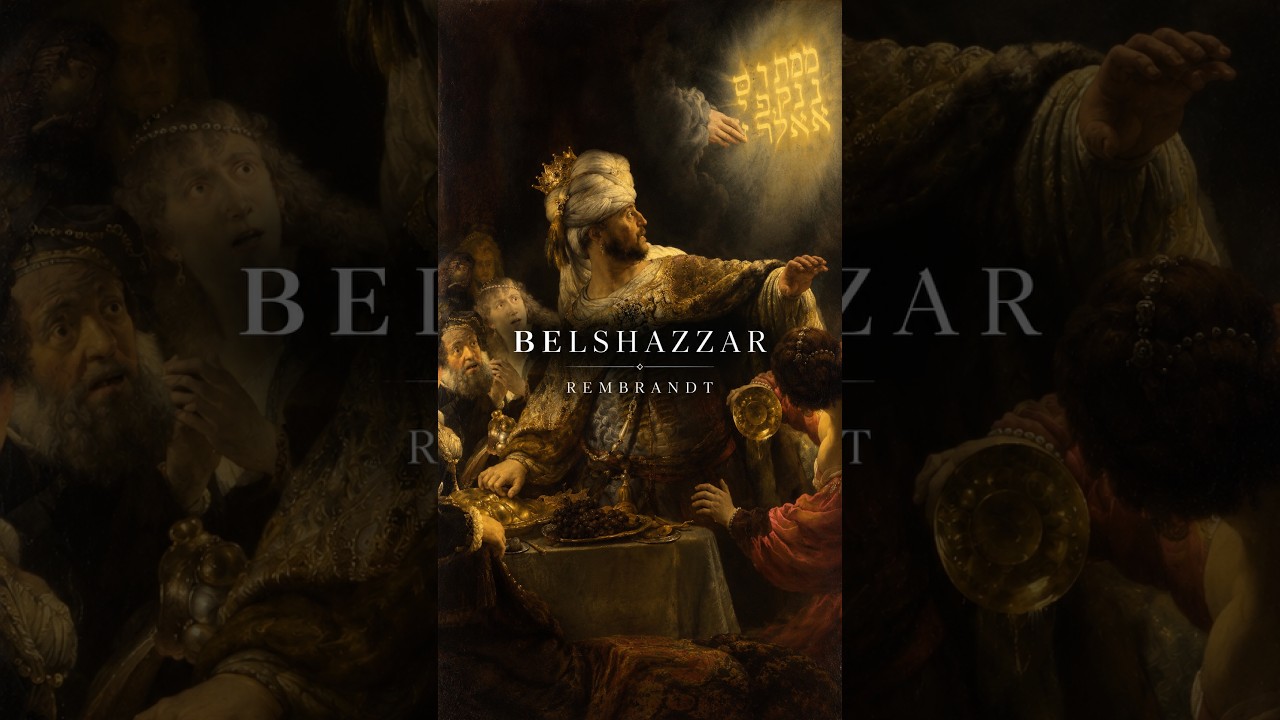
Rembrandt’s Belshazzar’s Feast, painted around 1635, captures the terrifying moment a powerful king realizes that his fate has already been decided. The story comes from the Book of Daniel in the Old Testament and takes place during an extravagant banquet held by Belshazzar, ruler of Babylon.
According to the biblical account, Belshazzar hosts a massive feast for a thousand of his nobles. During the celebration, he orders that sacred gold and silver vessels taken from the Temple in Jerusalem be brought into the banquet. Belshazzar, his nobles, wives, and concubines drink wine from these holy objects while praising idols made of gold, silver, bronze, iron, wood, and stone.
Then something impossible appears.
A mysterious hand emerges from nowhere and begins writing glowing words on the wall.
Rembrandt freezes the exact second Belshazzar sees it. The king violently twists away from the supernatural hand, his eyes fixed on the writing while the people around him recoil in confusion and fear. Wine spills, dishes are disturbed, and the celebration instantly becomes a scene of panic.
The mysterious inscription reads Mene, Mene, Tekel, Upharsin.
Belshazzar cannot understand its meaning, so Daniel is summoned to interpret the message. Daniel explains that the words represent a divine judgment against the king. His reign has been numbered and brought to an end. He has been weighed and found wanting. His kingdom will be divided and given to the Medes and Persians.
The terrifying part of the story is what happens next.
According to the Book of Daniel, Belshazzar is killed that very night.
The supernatural writing is therefore not simply a warning about something that might happen. It announces a judgment that is already approaching. Belshazzar is staring directly at the message predicting the destruction of his power only hours before his death.
Rembrandt intensifies the moment through dramatic light and darkness. The glowing writing becomes the brightest part of the painting, illuminating Belshazzar’s face, luxurious clothing, jewelry, and enormous turban. His wealth and royal appearance emphasize the contrast between earthly power and the mysterious force confronting him.
Only moments earlier, Belshazzar believed himself powerful enough to take sacred objects and use them during his feast. Now he cannot even understand the words appearing directly in front of him.
The painting is also the origin story behind an expression still used today. The phrase “the writing on the wall” describes a clear sign that disaster or failure is approaching. Its meaning comes directly from the biblical story of Belshazzar.
Rembrandt was one of the greatest painters of the Dutch Golden Age and a master of dramatic storytelling through light, expression, and movement. In Belshazzar’s Feast, he does not show the king’s eventual death. Instead, he chooses something psychologically more powerful.
He shows the moment Belshazzar realizes something is terribly wrong.
A feast becomes a nightmare. A king becomes helpless. A mysterious hand appears from the darkness and writes only a few words.
And before the night is over, Belshazzar will be dead.
#Rembrandt #BelshazzarsFeast #BiblicalArt #ArtHistory #PaintingExplained
- Category
- Fap tribute
- Tags
- Rembrandt, Belshazzar, Belshazzars Feast
Commenting disabled.
Up Next
Autoplay
-
13:16

Team UT: Đại chiến Bánh Phồng Tôm Cà Mau Hot TikTok - 45% thịt tôm thật nhưng có thật như quảng cáo?
-
32:35

TIỂU THƯ THẤT THẾ | Nhà Ai Cũng Thế Phần 32 | Phim Tình Cảm Gia Đình Hay Nhất Gãy TV
-
5:36:08

Hot Death God In MY Local Area!? - A Date With Death 【NIJISANJI EN | Fulgur Ovid】
-
02:51

Poonam Pandey LAST LIVE Session before death || Poonam Pandey Last Video before Death
-
4:20:16

???? WHY IS DEATH SO BABYGURL??? | A Date with Death - Beyond the Bet DLC
-
02:59

Gal Gadot Sexy Mashup 2017????FAP TRIBUTE + NUDE PHOTOS IN THE DESCRIPTION 1
-
00:59

charlie d'amelio fap tribute
-
02:55

FAP TRIBUTE #40 - SVETA BILYALOVA
-
05:37

Taylor Swift | FAP TRIBUTE | SEXY COMPILATION
-
00:11

Yummy Fap Tribute Remastered Ultimate Collection Edition 4k HD