
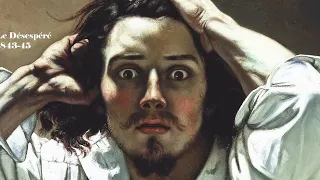
Gustave Courbet, had a spirit so fierce, that he declared himself the "proudest and most arrogant man in France." In the Paris Salon, between the folds of 1850 and 1851, he unveiled a tempest with his bold canvases birthed in Ornans, his ancestral village nestled in the heart of Franche-Comté. Among these, "The Stonebreakers," crafted in the twilight of the 1840s, faced its demise under the wrath of World War II, a lost jewel of realism.
Also, from that fertile period, "A Burial at Ornans" graced the halls of Musée d'Orsay, challenging the art world’s conventions by scaling everyday life to the grandiose canvases once reserved for historical epics, rendered in stark, unembellished truth. Critics, confounded by the raw, unpolished visages in Courbet's works, scorned the supposed grotesquery of his figures, dismissively branding them as "peasants in their Sunday best."
Scandal wove itself through Courbet's career, often at his own behest, as he navigated the tumultuous seas of French art. Born under the summer sun of June 1819, he charted a course through the nineteenth century, anchoring for the final time in the winter of 1877. A vanguard of the Realism movement, Courbet painted only that which his eyes could witness, eschewing the academic fetters and the ethereal allure of Romanticism.
His fierce independence blazed a trail for those who would follow, from the Impressionists to the Cubists, marking him as both an innovator and a courageous voice in the artistic dialogues of his time. Through his brush, the unidealized faces of peasants and laborers found their epic portrayal, traditionally the domain of saints and heroes.
Commenting disabled.
Up Next
Autoplay
-
22:02

Gustave Courbet - The Life of an Artist
-
06:00

ANTONIO DONGHI - Italian Magic Realist Painter
-
00:58

Gustave Courbet: The Central to The Emergence of Realism in the mid 19th century #shorts #shortvideo
-
08:12

Emile Munier ???????? (1840 – 1895) | A French academic Painter | ArtLiveAndBeauty
-
07:43
Painting The Most Realist Nude
-
02:59

Gal Gadot Sexy Mashup 2017????FAP TRIBUTE + NUDE PHOTOS IN THE DESCRIPTION 1
-
00:59

charlie d'amelio fap tribute
-
02:55

FAP TRIBUTE #40 - SVETA BILYALOVA
-
05:37

Taylor Swift | FAP TRIBUTE | SEXY COMPILATION
-
00:11

Yummy Fap Tribute Remastered Ultimate Collection Edition 4k HD
