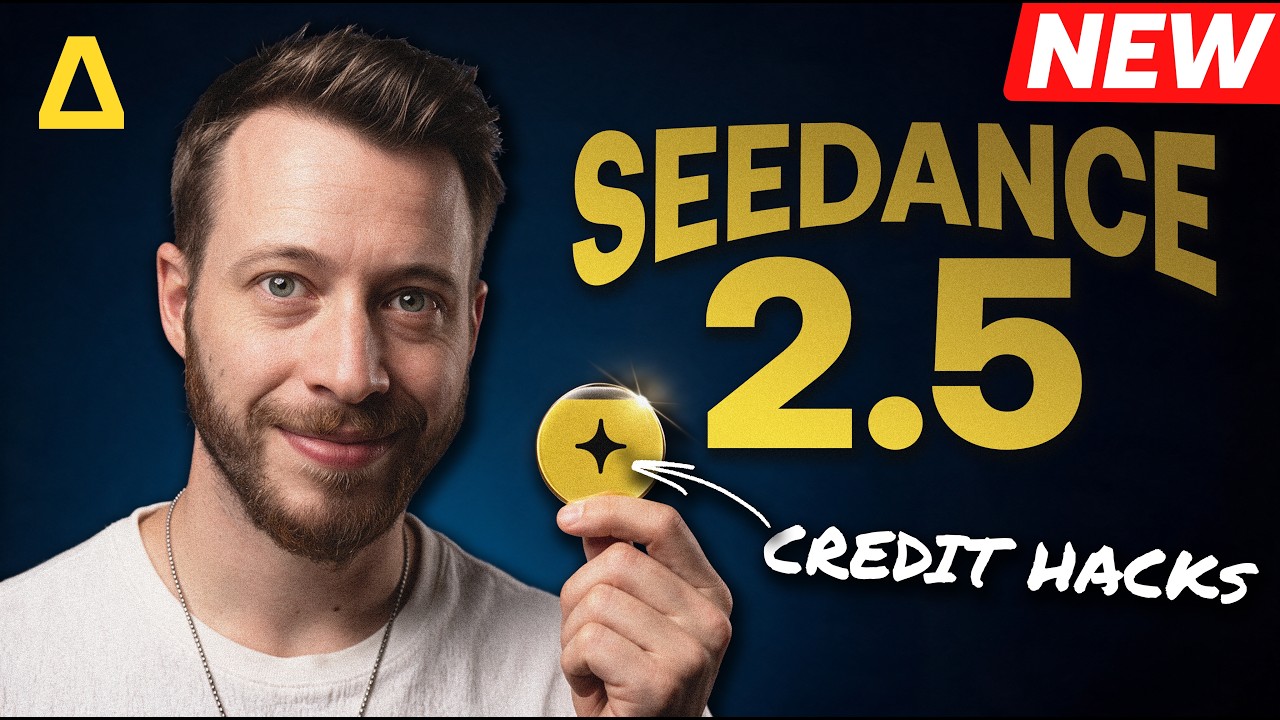
Seedance 2.5 is incredible — but easy to waste half your credits if you don't know what you're doing. Everything I've learned since launch: prompting structures, managing 50+ references, saving credits in 1080p, and troubleshooting failed generations. Over a million credits spent so you don't have to.
No cherry-picked reel — real failures, and how I fixed them without a full re-generation.
Stick around for a giveaway: 3 annual Artlist subscriptions.
In this video:
Why the new 32s limit isn't the real upgrade
Structuring a multi-scene prompt live
Fixing a near-miss without a full re-render
Seedance 2.5 vs. 2.0, side by side
Why maxing out 50 references backfires
Organizing reference-heavy prompts
Image grids to save credits on options
Audio adherence test across versions
Two workflows: solo creation vs. locked pre-production
Viewport/clay renders as references
Your own footage as a camera-movement reference
Timestamps:
00:00 – Intro
00:44 – Why more generation time isn't automatically better
01:45 – Building a multi-scene prompt with Claude (live walkthrough)
04:09 – First generation results — spot the 2 mistakes
04:45 – Fixing a failed generation without starting over
07:56 – Seedance 2.5 vs. 2.0 comparison
08:34 – The truth about the 50-reference limit
09:01 – Every reference is a prompt in itself
10:16 – How to organize a reference-heavy prompt
12:25 – Micro-comedy sitcom example (saving credits with image grids)
15:38 – Audio reference adherence test (2.0 vs. 2.5)
17:52 – Two workflows: flexible solo vs. locked pre-production
18:56 – Car commercial pre-production walkthrough
21:43 – Chunking multi-scene generations for quick cuts
22:36 – Using viewport/clay renders as references
25:19 – Real footage as a camera-movement reference
26:21 – Giveaway + outro
???? Giveaway: 3 annual Artlist subscriptions — not first come, first served. To enter: like, subscribe, and comment what you'd use Seedance 2.5 to create.
???? Free prompt templates mentioned in this video:
(copy and paste the following below into your LLM to help it to understand how to prompt correctly for you:
---
Use this to outline your prompt in your own words. This is a structural guide, not a fill-in-the-blank form — the bracketed notes describe what goes in each section, not literal text to type.
References
List every reference as a numbered tag, in order, stating what it shows and exactly what to match from it. Use as many as your scene needs — characters, locations, props, style references. Number sequentially within each type: @img1, @img2... for every image regardless of subject, @vid1, @vid2... for video, @aud1, @aud2... for audio.
@img1 — [what this shows] — match: [exact attributes to pull, e.g. face shape, hairstyle, skin tone]
@img2 — [e.g. same character's full body] — match: [build, height, exact outfit]
@img3 — [e.g. a location or set] — match: [architecture, materials, color palette, lighting]
@img4 — [e.g. a prop or object] — match: [exact shape, material, color, any text/logo]
@vid1 — [camera move or action reference] — match: [the exact movement/timing to replicate]
@aud1 — [dialogue, SFX, or music] — match: [exact words/timing/cadence, or sound character]
If a reference's role changes partway through the sequence (wardrobe change, location switch, prop swap), state explicitly which shot that change takes effect at.
Technical / Style
State once, up top — this governs every shot rather than being repeated per-shot:
Camera body / lens character
Film look (grain, flares, chromatic aberration, depth of field)
Aspect ratio
Framing rules
Transition / Pacing Rule
Pick the one rule that connects your shots and hold it throughout, unless variation is intentional:
Hard whip-pans only
Fast cuts only
No fades
Continuous unbroken motion
Duration & Shot Count
Decide roughly how long the sequence runs and how many shots it's broken into. Shorter, punchier shots suit fast-cut/whip-pan sequences; longer shots suit anything that needs to breathe.
Shot Breakdown
Break the sequence into as many shots as your story needs. For each one: what's physically happening, where the camera is and how it moves, how the shot opens, and what happens at the end that motivates the cut or whip into the next one.
Shot 1 — [detail]
Shot 2 — [detail]
Shot 3 — [detail]
...
Shot [last] — [if your sequence ends on a twist or reveal, this is where it lands — describe the pull-back or payoff with the same level of detail as every other shot, including how it resolves and how the sequence ends]
---
(end of prompt)
► Subscribe to our channel: https://bit.ly/AL-YTsubscribe
► Follow Artlist on:
Instagram: https://instagram.com/artlist.io
TikTok: https://www.tiktok.com/@artlist.io
Facebook: https://facebook.com/Artlist.io
X: https://twitter.com/Artlist_io
► Check out our blog: https://artlist.io/blog
No cherry-picked reel — real failures, and how I fixed them without a full re-generation.
Stick around for a giveaway: 3 annual Artlist subscriptions.
In this video:
Why the new 32s limit isn't the real upgrade
Structuring a multi-scene prompt live
Fixing a near-miss without a full re-render
Seedance 2.5 vs. 2.0, side by side
Why maxing out 50 references backfires
Organizing reference-heavy prompts
Image grids to save credits on options
Audio adherence test across versions
Two workflows: solo creation vs. locked pre-production
Viewport/clay renders as references
Your own footage as a camera-movement reference
Timestamps:
00:00 – Intro
00:44 – Why more generation time isn't automatically better
01:45 – Building a multi-scene prompt with Claude (live walkthrough)
04:09 – First generation results — spot the 2 mistakes
04:45 – Fixing a failed generation without starting over
07:56 – Seedance 2.5 vs. 2.0 comparison
08:34 – The truth about the 50-reference limit
09:01 – Every reference is a prompt in itself
10:16 – How to organize a reference-heavy prompt
12:25 – Micro-comedy sitcom example (saving credits with image grids)
15:38 – Audio reference adherence test (2.0 vs. 2.5)
17:52 – Two workflows: flexible solo vs. locked pre-production
18:56 – Car commercial pre-production walkthrough
21:43 – Chunking multi-scene generations for quick cuts
22:36 – Using viewport/clay renders as references
25:19 – Real footage as a camera-movement reference
26:21 – Giveaway + outro
???? Giveaway: 3 annual Artlist subscriptions — not first come, first served. To enter: like, subscribe, and comment what you'd use Seedance 2.5 to create.
???? Free prompt templates mentioned in this video:
(copy and paste the following below into your LLM to help it to understand how to prompt correctly for you:
---
Use this to outline your prompt in your own words. This is a structural guide, not a fill-in-the-blank form — the bracketed notes describe what goes in each section, not literal text to type.
References
List every reference as a numbered tag, in order, stating what it shows and exactly what to match from it. Use as many as your scene needs — characters, locations, props, style references. Number sequentially within each type: @img1, @img2... for every image regardless of subject, @vid1, @vid2... for video, @aud1, @aud2... for audio.
@img1 — [what this shows] — match: [exact attributes to pull, e.g. face shape, hairstyle, skin tone]
@img2 — [e.g. same character's full body] — match: [build, height, exact outfit]
@img3 — [e.g. a location or set] — match: [architecture, materials, color palette, lighting]
@img4 — [e.g. a prop or object] — match: [exact shape, material, color, any text/logo]
@vid1 — [camera move or action reference] — match: [the exact movement/timing to replicate]
@aud1 — [dialogue, SFX, or music] — match: [exact words/timing/cadence, or sound character]
If a reference's role changes partway through the sequence (wardrobe change, location switch, prop swap), state explicitly which shot that change takes effect at.
Technical / Style
State once, up top — this governs every shot rather than being repeated per-shot:
Camera body / lens character
Film look (grain, flares, chromatic aberration, depth of field)
Aspect ratio
Framing rules
Transition / Pacing Rule
Pick the one rule that connects your shots and hold it throughout, unless variation is intentional:
Hard whip-pans only
Fast cuts only
No fades
Continuous unbroken motion
Duration & Shot Count
Decide roughly how long the sequence runs and how many shots it's broken into. Shorter, punchier shots suit fast-cut/whip-pan sequences; longer shots suit anything that needs to breathe.
Shot Breakdown
Break the sequence into as many shots as your story needs. For each one: what's physically happening, where the camera is and how it moves, how the shot opens, and what happens at the end that motivates the cut or whip into the next one.
Shot 1 — [detail]
Shot 2 — [detail]
Shot 3 — [detail]
...
Shot [last] — [if your sequence ends on a twist or reveal, this is where it lands — describe the pull-back or payoff with the same level of detail as every other shot, including how it resolves and how the sequence ends]
---
(end of prompt)
► Subscribe to our channel: https://bit.ly/AL-YTsubscribe
► Follow Artlist on:
Instagram: https://instagram.com/artlist.io
TikTok: https://www.tiktok.com/@artlist.io
Facebook: https://facebook.com/Artlist.io
X: https://twitter.com/Artlist_io
► Check out our blog: https://artlist.io/blog
- Category
- Fap tribute
- Tags
- Music licensing, Artlist, Artlist.io
Commenting disabled.
Up Next
Autoplay
-
00:10

Minecraft Animation???? #shorts #minecraft #minecraftshorts #realistic #fyp #minecraftmoments #tikto
-
00:39
Realistic Panga drawing videos #realisticdrawing #realistic #drawing #shorts #tiktok
-
06:00
You need to be more REALISTIC about NOFAP!
-
00:10

Minecraft Animation???? #shorts #minecraft #minecraftshorts #realistic #fyp #minecraftmoments #tikto
-
3:25:35
Рисую в прямом эфире в Realistic Paint Studio на Windows 11
-
02:59
Gal Gadot Sexy Mashup 2017????FAP TRIBUTE + NUDE PHOTOS IN THE DESCRIPTION 1
-
00:59

charlie d'amelio fap tribute
-
02:55

FAP TRIBUTE #40 - SVETA BILYALOVA
-
05:37

Taylor Swift | FAP TRIBUTE | SEXY COMPILATION
-
00:11

Yummy Fap Tribute Remastered Ultimate Collection Edition 4k HD